

code red tree-mergency: mulch volcanoes 🌳🌋
once you see it, you can never *unsee* it.

You might notice that things look a little different around here! I gave the newsletter a little zhuzh recently, along with turning on a paid subscription option. Paid subscriptions will help fund the time, research, writing, and care that go into creating this newsletter, but all my posts will continue to be free and nothing will be hidden behind a paywall. It’s my little way of grappling with a personal case of everything-is-a-subscription-these-days-itis, while recognizing that this is the world we live in these days and this has turned into an actual (awesome!) job. I’m still playing around with what it might look like as an added bonus for paid subscribers —perhaps a private Discord groupchat? Substack chat seems too cluttered, but please hit me up if you have other suggestions. Thank you for your time and attention, as always! I never take either for granted.
“I am the Lorax. I speak for the trees. I speak for the trees for the trees have no tongues.”
 -  Dr. Suess

A few weeks ago, stranded with a slowly-going-flat tire while on a trip to New York, we found ourselves in a Honda dealership. And at the risk of already going off on a tangent, I fear I must tell you why we had a slowly-going-flat tire. It all started with a pitstop in Connecticut for coffee, and ended with a man driving a pick-up truck that was loaded skyhigh with detritus and furniture, none of which was adequately tied down. We were going straight, he banged a right, and as we were passing, a dresser went careening off the bed of his truck right towards the front of our vehicle. Thanks to quick reaction time from my husband, he swerved, but the dresser still clipped the front of our truck and the front left wheel.
We pulled over, I quickly hopped out to inspect our vehicle for damage, and upon seeing none that was especially concerning, turned back towards the careless driver and unleashed a tirade that, honestly? Felt downright incredible.
“WHAT THE $%&* IS WRONG WITH YOU? LEARN HOW TO USE A #@%&*!& RATCHET STRAP YOU DUMB PIECE OF $%&#”
Then, I quickly hopped my buns back into the car and we took off. I figured that was one of the most emasculating things a woman could say to a man. And truly, I feel like it was warranted.
Now, fast-forward 24 hours and we got in the car to meet up with my husband’s brother and his family for a little sledding, only to realize that the left front tire pressure was low. Like, 10PSI lower than the others. And was continuing to lose air. So after a short little sled session, we high-tailed it to the Honda dealership which was luckily only a mile down the road. They confirmed that the inner wall of the tire was indeed messed-up, and said they could fix it ASAP.
So there we were, stranded at the Honda dealership with two hungry kids and some time to kill. Thankfully, my sister-in-law and our niece showed up with snacks like little guardian angels, and double thankfully, the dealership was loaded to the hilt with children’s books. I spotted The Lorax on the top of the stack and, upon realizing that somehow I’d never actually read the book, cracked it open and started reading to Reese.
And you guys? I knew the gist of the story but holy moly, it’s so sad and heart-wrenching in the accuracy of it all. In no time, I was tearing up, and when I reached the part with the quote at the top of the newsletter, I was full on ugly crying. THE LORAX SPEAKS FOR THE TREES BECAUSE THE TREES HAVE NO TONGUES!

Anyways, today I’d like to chat about trees and mulch, and about some very pervasive landscaping habits using the latter that are harmful to the former.
If you live in suburbia, chances are you might see some new build landscaping that looks a little something like this:


To the untrained eye, some might wonder what the problem is. After all, it looks neat and tidy and refreshed, right? To an arborist, or just an armchair tree enthusiast who has read their fair share of books about trees, it’s a code red tree-mergency because this is a great way to kill a tree. By covering up a tree’s root flare, you’re essentially suffocating it. The root flare is the area where the main roots of a tree spread out from the trunk, and it provides structural stability, is crucial for nutrient uptake, and is a major overall health indicator.
Here’s what University of New Hampshire Extension has to say regarding mulch volcanoes:
Volcano mulching is an improper tree care technique where, year after year, mulch is piled against the trunk of a tree. Properly planted trees (or naturally grown trees) will develop a characteristic root flare near ground level. Volcano mulch buries the root flare or, in young trees, prevents a proper flare from ever developing. Trees without proper root flare lack stability and are more prone to windthrow. Mulch piled against a tree’s stem also encourages disease and decay because the bark is almost always wet. To make matters worse, huge piles of mulch interfere with good root development. For example, if the top few inches of soil are always moist, roots may not spread deeply into the soil. During a summer drought, your tree may be left high and dry!
If you’d like some more examples of tree disasters, this r/tree subreddit is a great spot to check out. It covers all of the usual tree-planting ills such as too-deep planting, volcano mulch, tree rings, landscape fabric, and improper pruning.
By no means am I a tree expert, so if you have questions about your particular trees, a great place to ask them is at your local Cooperative Extension office. They’re some of the most trustworthy places to get science-based tree and garden advice, usually for free. Also, googling “your state + county forester” may yield some helpful results. Alternatively, you could seek out an ISA Certified Arborist in your area, and make sure they specialize in tree health.
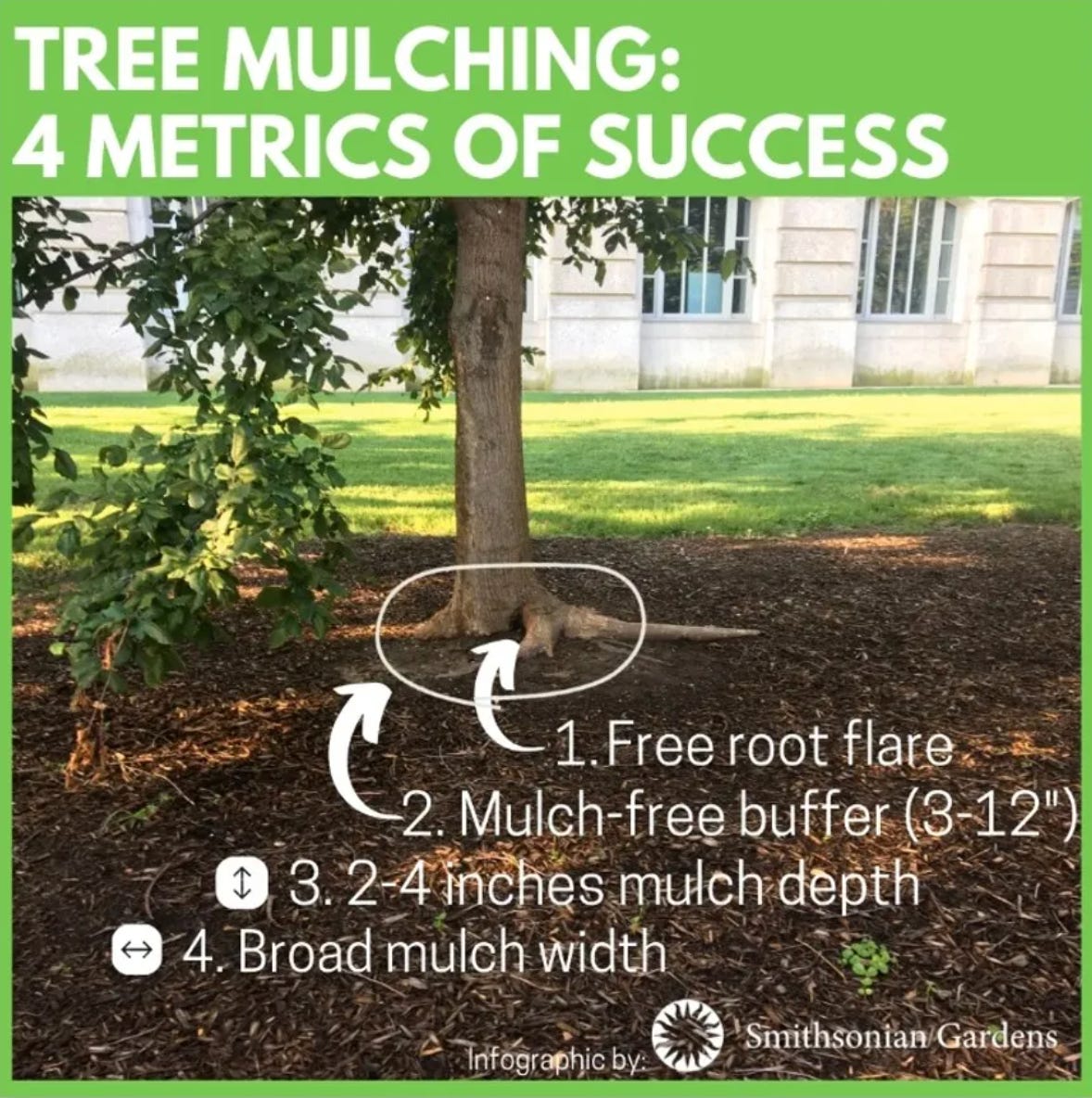
The most important thing is to really familiarize yourself with the root flare area of a tree and make sure it’s visible. I tried coming up with a little rhyme like “leaves of three, let me be” and I thought for way to long about it and finally came up with “show you care and find the flare” or “volcano is bad, but flare is rad.” Neither is great, I admit. This is the area you want to focus on:
Proper Root Flare


Oh man, I thought mulch was good!?
Let me emphatically say that mulch is good! Maybe one of the best things you can do for your garden and your trees. Mulch helps maintain soil moisture, control weeds, and provide slow release nutrients back into the soil. However, there can be too much of a good thing. When mulching with organic materials like hardwood bark, aim to make the mulch ring as wide as you can. Also, you only need a thin layer, about 2 to 3 inches deep. And most importantly, if any mulch ends up against the tree trunk, gently pull it back so the base of the tree can breathe.
If mulch volcanoes are so bad, then why do I see them all over the place?
When homeowners see landscape professionals piling mulch up against tree trunks, they assume that’s the right way to do it. But why do landscape companies do it? My guess is that time is money, and volcanoes are fast, visually dramatic, and as such, have become the industry norm over time. Piling mulch high around a trunk makes a space look freshly maintained, hides weeds, and reduces the need for precise edging. It also uses more mulch, which can align with how jobs are priced.
But what if I like the look of fresh mulch in the spring?!
Great, me too! You can pull back last season’s layer, cart it away to your compost pile, then refresh with new 2-3” layer, leaving the root flare exposed, and making sure there’s no contact with the trunk.
Crap, I have a mulch volcano or know someone who does. What can I do? And what can I say without sounding like a pretentious jerk?
Firstly, go easy on yourself. Mulch volcanoes are incredibly common and almost never come from bad intentions. People are just trying to care for their trees, and it’s from a lack of education more than anything else. But when you know better, you can do better! Gently pull the mulch back so you can see the base of the trunk and the trunk flare. Spread the mulch out wider instead of deeper and keep it to about two or three inches thick. You’re not removing mulch, just redistributing it in a way the tree can actually benefit from.
If it’s someone else’s tree, lead with curiosity, not correction. Something like, “I subscribe to this super cool gardening newsletter (shameless plug, what can I say!) and just learned this cool stuff about tree health and thought it was interesting” goes a long way. You can mention that piling mulch against the trunk can trap moisture and cause rot over time, and that trees do better when the base can breathe. Framing it as something you also didn’t know is a good technique, because obviously no one likes feeling shame.
This post, Mulching Landscape Trees, from Penn State Extension is wonderfully helpful in showing proper techniques, as is this document from the Missouri Department of Conservation. Whatever you do, please don’t check out Pinterest because it’s rife with AI slop tree mulch nonsense, and other landscaping ~hacks~ that would make an arborist fly into a Hulk-rage.
Once spring rolls around, it is my sincere hope that you all will now be equipped (if you weren’t already, which many of you are I’m sure!) to confidently walk the streets of your yard and neighborhood, pinpointing which trees are healthy and which are sending up a big SOS.
Because we must speak for the trees, for trees have no tongues.
Until next (pizza) Friday,
Amy




One of the leaders in my Master Gardener program opens up the weekly Zoom lessons the same way every week, and I so look forward to it. So I decided to adapt it to this section of the newsletter! He’ll welcome and greet everyone, then rattle off sunrise, sunset, daylight hours, and moon phase data for the current day. I’ll be basing mine on data for Worcester, MA, my closest city.
Sunrise: 7:06 am | Sunset: 4:51 pm | Day length: 9 hours, 44 minutes | Moon phase: Waxing Crescent | Weeks until last frost: 16
Now if you’re newer to gardening, or honestly even a more experienced gardener who recently moved, “last frost” dates can be confusing. Because they’re not set in stone, but rather given as an average date. And if you’ve raised seeds and tended them indoors, you want to be a little conservative in your planting, especially with warmer weather crops. As we get into planning season, it’s helpful to determine your last frost date, specific to your town’s microclimate. For instance, this chart from The National Garden Association shows the probabilities of certain temperatures by dates, which is helpful for planning purposes.
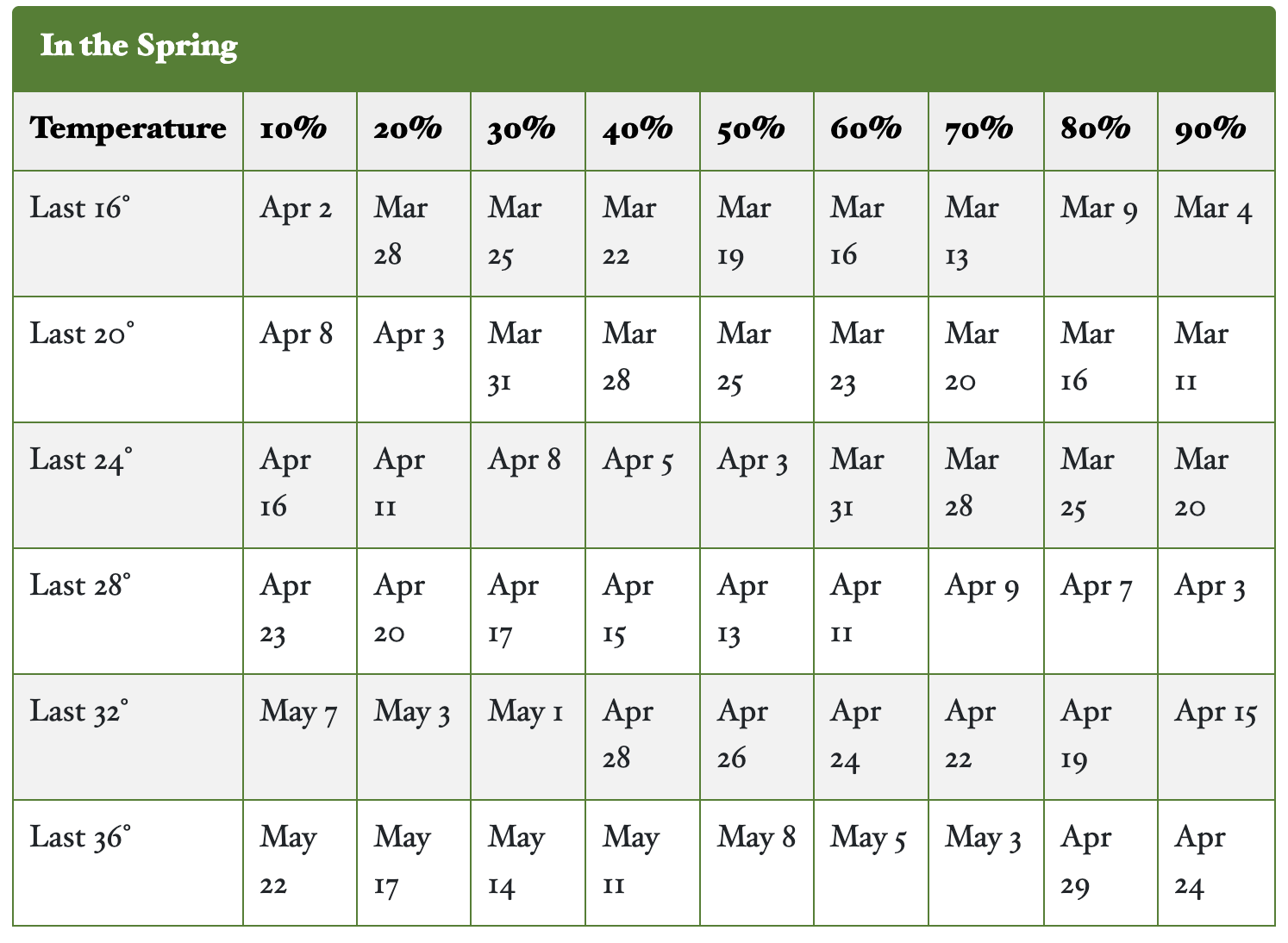
Technically, 32º is the temperature where water freezes, but frost can form even above this benchmark, so think of 36º as the danger zone. The air is colder high above the ground, so frost that forms up there can fall onto your tender plants. Based on this chart, and from speaking with a local nursery owner when we first moved to our town, I use May 20 as our real last frost date, and you can see in the chart that there’s a 90% chance that there will be no 36º nights by May 22. Meaning, I never put my tomatoes or peppers or other warm weather loving plants in the ground before that date. But it’s tricky, because if I were to just plug my zip code into the first search result in Google, it yields the date of April 29. And that’s on nuance, baby!
We set up this weather station back in 2022 and continue to nerd out over it daily. It’s helpful for observing the exact weather in your own backyard, so you can make informed gardening decisions. Plus it’s fun and nerdy to exclaim, “Wow, we got 8.75” inches of rain last month!”
Truthfully, despite being eager to kickstart this growing season (last year was my worst gardening year in a decade), I’m still a few weeks out from starting anything. In the meantime, I intend to hunker down and finally get to ordering seeds! If you’re in the same boat, here are some resources you may find helpful:

Words of Radiance by Brandon Sanderson - For the longest time, I avoided reading fiction because I (wrongly) felt that since I didn’t have as much time to devote to reading as I used to before having kids, that I should be using my precious reading time to learn something and enrich myself. Obviously, I’ve seen the error of my ways! Fiction has so many benefits, not the least of which it’s simply a delight. The Stormlight Archive series is rocking my world —if you’re a romantasy lover but have found some of them to be lacking a bit, then maybe check out some epic fantasy like this. But don’t get it twisted, as I will be getting ACOTAR 6 on release day. I just personally find I love the deep world-building and writing of a straight up fantasy series like this!
Botany for Gardeners: An Introduction to the Science of Plants by Brian Capon - This has been great to read alongside my first couple weeks of Master Gardener textbook reading. If you’re already a plant-lover, this book will make you extra appreciative and astonished at just what little miracles plants truly are.

Despite what you may feel about Tony Robbins, this is a really insightful discussion on the broad societal implications of the future of AI. Hint: they’re not very good! Except for enriching those with a vested interest in total AI adoption! One of my favorite newsletters, Garbage Day, succinctly puts it, “All OpenAI wants is to make a single piece of software that can swallow the entire internet, and devour the daily machinations of lives, and make us pay to interface with our souls, and worm its way into the lives of everyone on Earth.”

Making the same recipes over and over again. This quite possibly might be a full-blown newsletter topic soon, because ever since I saw this TikTok, I haven’t been able to stop thinking about it. The gist of it (if you don’t have TT, or simply want a tl;dr) is that we’re all stressed out about meal planning and grocery shopping because never before in history have we been trying to cook new recipes all the time. We’re under the false idea that we need to eat vastly different foods every single day, and hit new genres and cuisines weekly. How did our moms, grandmothers, and great-grandmothers (or the men in your family!) cook? The same classics made over and over and over again. I’ve been feeling this for a while, honestly. I love getting inspired to try new dishes, and personally love many food creators (and heck, I have recipes on my site!), but at some point it just feels like some arbitrary goals we’re setting for ourselves and a different kind of overconsumption. I’m a self-proclaimed cookbook collector, so I love trying new recipes, but this year I’m keeping it to maybe one a month. Instead, I want to focus on nailing the family classics, and building out my skills as a bombass home cook. And I can’t do that if I’m flip-flopping to tons of different recipes all the damn time!
The snow that’s been blanketing the East Coast seemingly all winter. We have around 8” on the ground, and a whopping 15” forecast for this weekend. Who knows how much we’ll end up getting, but this is the snowiest winter we’ve had since moving back east in 2020. It feels like the kind of New England winters I remember as a kid, and I love that our kids get to experience the winter wonderland outside.
Traitors! Where have I been?? I’ve heard friends raving about Traitors for a while now and finally checked it out this season. The magical combination of Dorinda, Lisa Rinna, Rob from Love Island, and Maura Higgins roped me in and I’m hooked!

How to Choose Seeds With Flavor in Mind [New York Times]
2026 Is the Year of the Cabbage: Meet the Most Underrated Leafy Green [Vogue] Honestly I’m not sure how everyone has been sleeping on cabbage this long because it’s essentially just cheaper kale and it lasts forever in the fridge and is so incredibly versatile, but I’ll take it! I just hope it doesn’t jack the price up because $0.79/lb is music to my budget-friendly shopper ears.
Madame Microwave: Meet Jehane Benoît, Canada’s grande dame of culinary nationalism. [Distillations Magazine]
Newly Digitized Records Reveal How Indigenous People Shared Their Knowledge of New Zealand’s Plants With Captain Cook’s Crew [Smithsonian Magazine]
‘This mysterious little beast is returning to our forests’: Rare images of Europe’s ‘ghost cat’ [BBC]
YEESSSSS to your comments about recipes and mealtime!! I've had similar thoughts lately about this (like also many other things in this modern capitalist world we live in) over-commodification of recipe development and sharing of mealtimes. So many of the recipes I see, even in places like the NYT or Bon Appetit, feel duplicative or overly complicated or called "fusion" for the sake of sounding fancy when in fact it's just what people sometimes to make a meal out of food in their fridge and pantry. I love to cook, but I'm also a busy mom who just needs to get dinner on the table and I don't have the luxury of time, nor the desire, to pour over dozens of new recipes to try every week. There's definitely some doubt that creeps in for me that I am not a good cook because I'm not out chasing new recipes all the time.
BUT!! I'm happier when I stop to remember--I'm actually a damn good cook, and I WANT to be known for the meals I create, even if it's the same meals I've cooked 100 times before! I WANT my kids to ask for recipes to their favorite meals when they get older, because that's what they want to cook for their kids because they remember how much they looked forward to that meal. I WANT the comfort of Friday pizza nights and Sunday morning waffles and other traditions.
It feels almost like the same thing as fast fashion and other over-consumption. We've created these cycles of demanding more-more-more, and have to put up this false front of not using something more than once or twice, because *how dare* we be seen actually USING something to the point of wear (like your dutch oven story!!)! Now it's turned into this constant reinvention of recipes and mealtime.
Clearly I feel quite passionate about this 😜
This is such a great breakdown of something most poeple never think about. The root flare explanation honestly made me go check my own trees and yep, guilty as charged. Love the framing around approaching neighbors without being preachy, thats usually whre things go sideways. Gonna pass this along to my HOA landscaping committee.