

the native plant debate
the nuances and resources to help you nail native planting this year

"Only in the last moment in history has the delusion arisen that people can flourish apart from the rest of the living world."
-E. O. Wilson
I’ve got native plants on the brain this week, as that was the weekly lecture series and reading topic for my Master Gardener program on Tuesday. That, and we’re still buried in snow with no sign of it letting up anytime soon, so my mind continuously daydreams about spring garden plans.
Now, native plants weren’t even a blip on my radar in my first few years of gardening. I was laser focused on exclusively growing vegetables, fruits, and herbs in my California urban garden. Heck, I had to force myself to plant flowers because I knew they were important for pollinators, but I was reluctant to give up my precious raised bed space for something * gasp * that wasn’t edible!
Fast forward a few years, dozens of gardening books, a cross-country move to a new house, and continuing to learn about biodiversity and the decline in insect populations, native plants are constantly top of mind when I think about how I approach gardening.
But sometimes, the ~JuSt GrOw NaTiVe pLaNts!~ rhetoric can feel like a dismissive, gatekeeping mantra rather than actual helpful advice. And confusion abounds for good reason! Who, exactly, is the arbiter of what is or isn’t a native plant? What’s the timeline? Does it mean native to the continent? The state? The specific zip code? The goalposts move depending on who you talk to.
You might also be wondering if this means you can only grow native plants. Heck, I live and breathe this stuff and I had the same question! We know they’re good in theory, but can’t we grow some plants just because they look gorgeous? Peonies, I’m talking about you, you beguiling, non-native beauties.
This blog post from Garden Rant highlights the ridiculousness of these arguments:
We know from fossil record that dawn redwood Metasequoia glyptostroboides and ginkgo Ginkgo biloba were once found on the land mass we now call North America, but were wiped out by ice ages. Now that we can purchase these plants in nurseries and plant them successfully in our landscapes, are we bringing back a native, or are we introducing an exotic?
If one were to say it is an exotic because it wasn’t on this continent when “we arrived”, I can only raise my eyebrows at the arrogance. Who are we to choose that tiny speck of time, legitimized only because it happened to be the plant palette that was here when the first European set boot on the continent? That move introduced the most invasive species ever, the European settler. Who among us will volunteer to clear out, along with kith and kin and return this land to the “natives” (the human species, who by the way, crossed over on Berengia, the Siberian “land bridge” from Asia).
Native is a moving target. Look at what might happen if we pass laws that dictate that we plant only natives and that mandate removal of all non-natives. Where do we draw the line? Is my grandmother’s gardenia contraband? The daffodil bulbs from my other grandmother? Will I be required to rip out my small orchard of apples, pears and figs? Are edibles exempt? What about the crabapples that serve as great pollinators for my apples?
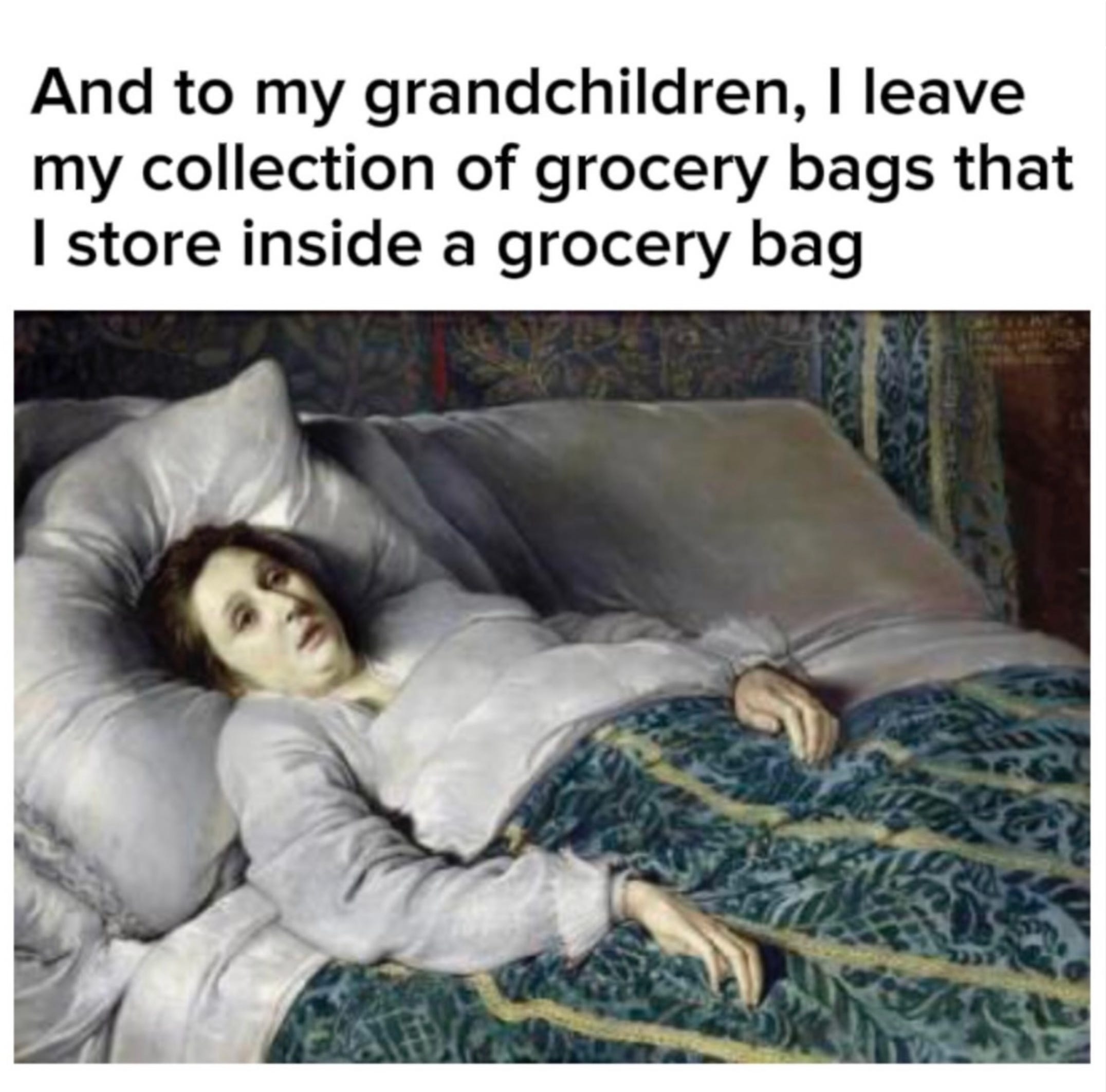
Once you take a peek behind the curtain of native plant gardening, you’re bound to find quite a bit of in-fighting, bickering, and general dissent as to the right way to go about gardening with native plants. One of my favorite horticulturalists, Rebecca McMackin, shared a funny meme that encapsulates the hair-splitting that can occur:
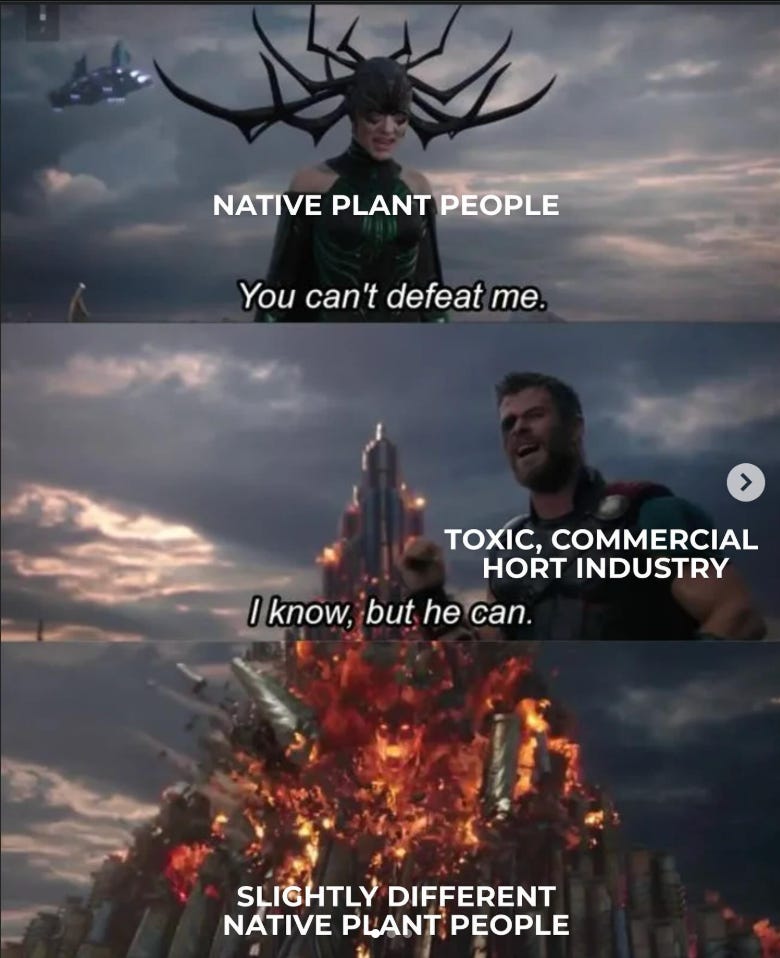
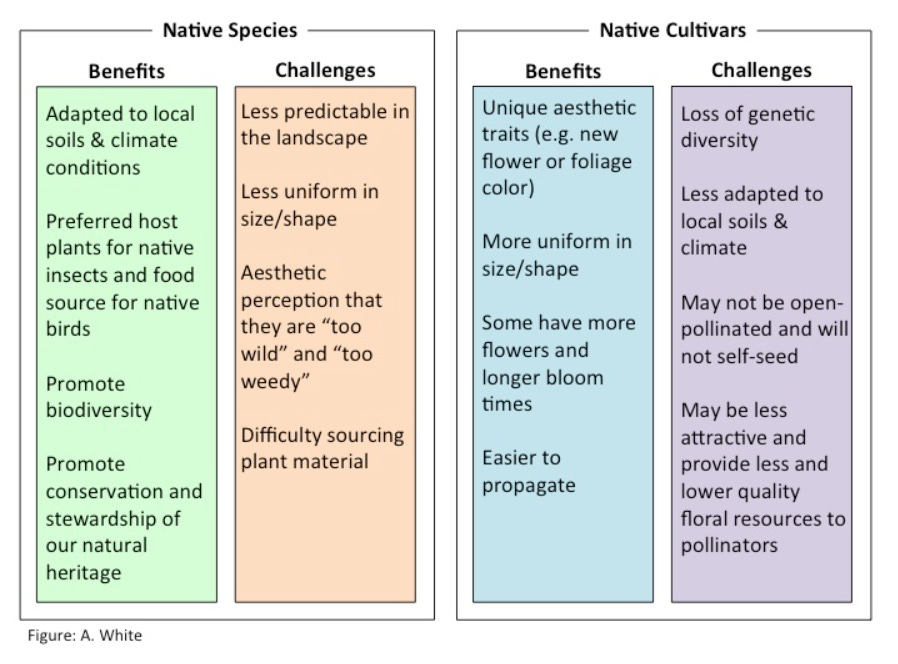
It feels like yet another case virtue-signaling purists attacking well-meaning people who are doing their best. One major point of contention in the native plant debate is the issue of “nativars” (native cultivar clones, often labeled with names in quotes, like Echinacea 'Pink Poodle') which purists claim don't provide the same ecological value as “straight species” wild plants.
A native cultivar is inherently stuck in its evolution, and contributes little to the gene pool of the species. This means that the plant cannot adapt and does not contribute to the perpetuation of the adaptability of the species, which can lead to endangerment of the wild plant types. And while nativars can have ecological value for generalist wildlife (i.e.; honeybees, bumblebees), the vast majority (roughly 90%!) of plant-feeding insects are specialists, adapted to digest only a limited suite of plant chemistries, often corresponding to a particular plant family or genus. You know, like monarchs only feeding on milkweed (Asclepias spp.), or Black Swallowtail butterflies only eating from plants in the carrot family (Apiaceae) such as dill, parsley, fennel, and wild carrot.
Speaking of insects, I always say that you catch more flies with honey than vinegar. So instead of shaming people who are interested in growing native plants, lead with gentle education instead of admonition. In my humble opinion, any native plant is a step up from the lovely but ecologically devoid exotic plants. And a straight species is an improvement from a native cultivar. It’s not about perfection, though.
This is what I feel like when I see native plant bickering online:
“Wait, WTF is a nativar"?”
A native cultivar or “nativar” is a cultivated variety of a native plant, that has been selected by humans (in nature or through repeated selections in a breeding program), cross-bred, and/or hybridized by botanists and plants breeders seeking desirable characteristics that can be maintained through propagation. 1 This can lead to changes in size, color, and length of bloom, all characteristics which can make flowers less recognizable to pollinators and significantly decrease the amount of high-quality food (pollen and nectar) available to them.
“Why should I even bother with native plants?!”
To protect wildlife habitat.
To maintain and conserve regional plant diversity.
They’re low maintenance once established (saves $$$!)
No need for chemical fertilizers.
Attracts beneficial insects which support the local ecosystem.
Deep roots, for erosion control and water filtration.
“I’m not a Vanderbilt, I can’t re-plant everything to be a native plant. Is there something I can do that will have an outsize impact?!”
Wow, what a perfect question and I’m so glad you asked! As a matter of fact, yes there is! If you aren’t in the mood to overhaul your entire garden (in this economy? Heck no.), then you can hone in on what have been dubbed by Tallamy’s research as “keystone species.” Essentially, these are native plants that do the heavy lifting in an ecosystem. Only about 5% of native plant genera act as keystone species, but that 5% of plants provides the food for 75% of the local caterpillar species.
A keystone species refers to those most productive native plants that serve as host plants for the caterpillars of Lepidoptera (butterflies and moths), and thus provide the foundation of our entire food web. Research has found that more than 5000 caterpillars are needed to raise a single nest of five baby Chickadees. Love birds?! Focus your efforts on plants that will provide critical food for them to raise their young.
RESOURCES FOR FINDING NATIVE PLANTS
Homegrown National Park —One of my personal favorite missions, founded by Doug Tallamy. I highly recommend these three books of his: Nature’s Best Hope, The Nature of Oaks, and Bringing Nature Home.
Xerces Society has handy PDFs available of pollinator-friendly native plant lists based on your particular region.
Flying Trillium Gardens & Preserve has a wonderful list of keystone species for butterflies and moths.
USDA PLANTS Database. This official government repository is more technical and scientific, but a great resource for the curious-minded.
Blazing Star Gardens has a wonderful bloom chart for native plants, focused on Northern growing zones. I’d double check this chart with a secondary source (keep reading for more) to ensure that the plant is truly local to your eco-region before purchasing something, though.
Audubon Society has a native plant database —plug in your email address and zip code, and you’ll be presented with a list of recommendations for your area, along with the birds the plants may attract. You can filter by plant type, birds you’d like to attract, and the kind of plant resources you’re interested in providing for wildlife.
So when you’re at the garden center this spring hunting around for native plants, don’t be surprised if you’re unable to find “straight species”. If you can, then huzzah! Stock up! Make sure to talk to the owner and thank them for carrying these ecologically critical plants. And if you can’t find any, then pull a Daniel Tiger and simply do your best.
Until next Friday,
Amy





Based on Worcester, MA data
Sunrise: 6:34 am | Sunset: 5:27 pm | Day length: 10 hours, 52 minutes | Moon phase: Waxing Crescent | Weeks until last frost: 12
Truthfully, it’s difficult for me to even wrap my head around starting seeds while looking out the window at the snow still blanketing our yard, and staring down the barrel of another 6” forecast for this weekend. And most of my seed starting trays are still buried in the snow out in the garden —shame on past Amy. And I haven’t sanitized any of them yet!
This weekend, I’ll hopefully start some onion seeds, and also try my hand at winter sowing some kale, cabbages, and collard greens. I know some people have had great success with this method but it has somehow eluded me thus far.
I’m also putting my money where my mouth is and will be sitting down to place a native seed order this weekend, once I wrap my head around exactly what I want to plant! It’s a lot of information, guys!
I’ll keep these links here for the next few weeks so they’re easy to find if the mood strikes:

Oathbringer by Brandon Sanderson
Into the Magic Shop: A Neurosurgeon's Quest to Discover the Mysteries of the Brain and the Secrets of the Heart by James R. Doty, MD

I’ve sent this to countless friends, and I can’t encourage you enough to give this a full listen. They dive into the research on short-form video and how it’s truly rotting our brains, the dangers of any kind of devices for children, social media dangers for teenagers, AI chatbots, and so much more.
And since it’s pertinent to the discussion, here’s my code for a Brick (that link!) which has been instrumental in helping my break my phone addiction this year. You get 10% off, and I get that 10%. Win-win, and we can all reclaim our brains from Big Tech!

Wings magazine from Xerces Society. More specifically known as “Wings: Essays on Invertebrate Conservation”, it’s published twice a year — in the spring and fall —and contains spectacular photos and fascinating research from leading scientists and conservationists.
Dropout.tv —Despite cutting all normal streaming services, we recently signed up for a Dropout subscription (to watch our current favorite show, Dimension 20: Fantasy High) without the ads on YouTube. If you love general silliness, improv, and a company prioritizes inclusivity and fair play for talent, then check it out! It’s all we watch currently.

How to Avoid Even the Unintended Results of Your Ecological Mistakes [NYT]
After Promising to ‘Make America Healthy Again,’ Trump Mandates Production of Cancer-Causing Glyphosate [Common Dreams]
Inside Thomas Edison’s Botanical Laboratory [Atlas Obscura]
Berry High Prices [Offrange]
3 flour brands are redefining how regenerative agriculture scales [Food Navigator]
Leading by admonishment doesn't really work. I hope I'm always encouraging with my content and when I give talks as a Master Gardener. I grow all sorts of everything. Gardening is a joy. Leading people through joy works really well at my talks. I grow tons of food, annual flowers for beauty, and plants that provide ecological services to our local wildlife, aka, native plants. I'm not going to apologize for growing Lavender in front of the Little Bluestem, Baptisia, Penstemon, and Garden Phlox. I'm not going to apologize about the fact that the Hummingbird Mint growing next to the Goldenrod and Big Bluestem is native to the Southwest and not my ecoregion. I love it, it's the best smelling plant in my garden, the hummingbirds and nectar robbing bees love it, and the deer don't eat it. I have Monarch Caterpillars eating my Milkweed, American Lady Caterpillars eating my Pearly Everlasting, Small Carpenter Bees nesting in the stems of my Smooth Aster, Goldfinches eating seeds, Longhorn Bees nesting in the ground, a freezer full of greens, zucchini, broccoli, cauliflower, and beans grown here as well as shelves of salsa, jam, onions, garlic, squash, teas, herbs, and spices grown here too. Perfection should never be the enemy of progress. I hope to always be encouraging, inclusive, and enthusiastic and hope that everyone else gets the "bug" too and develops a passion to want to do more. Happy gardening to everyone in 2026.
Thanks for this! We moved into a new house at the end of summer last year so I'm taking this growing season to see what's what before diving in, but *native plants only!!* has been a bit overwhelming. Of course I want to support the pollinators, but where to even begin?? And here you are, laying out the road map. Your content is always timely, particularly because I belive we're fairly close geographically and your posts keep me in line with my planting schedule. Anyway, just wanted to say once again how grateful I am for you!